skip to main | skip to sidebar

A More Conservative Union

The Foreign Policy Report

  • Climate Hype
  • Health Care
  • Home
  • The Drive-By Media Complex
  • The Economy
  • The Founding Documents of the United States of America
  • The One
  • The Partisan Playground
  • The Socialist Digest
  • Threats to Liberty

Friday, November 27, 2009

Obama to unveil his Afghan strategy Tuesday at West Point

The president is expected to announce that the U.S. will send more troops to Afghanistan. He also is likely to offer a plan for eventually withdrawing U.S. forces.

By Peter Nicholas
November 25, 2009 | 9:33 a.m.

Reporting from Washington - President Obama will roll out his new strategy for the Afghanistan war during a televised speech Tuesday at 8 p.m. Eastern time from the U.S. Military Academy at West Point, the White House said.

Obama, who has presided over at least nine meetings of his senior advisers devoted to the war, is expected to announce higher troop levels for Afghanistan while also detailing a plan for ultimately withdrawing U.S. forces and handing over security responsibilities to the Afghan government.

In announcing Obama's address to the nation, White House Press Secretary Robert Gibbs said that Obama has no appetite for an indefinite military presence in Afghanistan.

"We're in the ninth year of our efforts in Afghanistan," Gibbs told reporters in his White House office. "The president will want to walk through his decision-making process and give people a sense of the importance of our efforts, but reiterate for them that the president does not see this as an open-ended engagement."

He added: "Our time there will be limited, and I think that's important for people to understand."

Before traveling to West Point on Tuesday, Obama will privately brief members of Congress about his decision. The White House has asked the television networks for airtime.

For a president facing a raft of domestic and foreign policy challenges, Afghanistan is among the thorniest. Polls show the war to be unpopular, with Americans eager for an exit strategy. Liberal Democrats who comprise Obama's political base are loath to see him commit more troops.

Yet Obama's ground commander has said at least 40,000 more military personnel are needed for the mission to succeed. Presently, about 68,000 U.S. troops are stationed in Afghanistan. Obama himself has described Afghanistan as a crucial battleground in the effort to defeat Al Qaeda terrorists.

Obama has undertaken a weeks-long review process of strategy in Afghanistan, while Republican opponents have accused him of "dithering."

With lives at stake, Obama has said he did not want to rush the decision.

Gibbs said that "throughout this process, the president has repeatedly pushed and prodded not simply for, as I've said, how are we going to get a certain number of troops in, but what is the strategy? What has to be implemented ultimately to get them out?"

Whatever the number of new troops sent to the region, Obama has indicated he is determined to complete the mission in Afghanistan. At a news conference on Tuesday he said, "I've also indicated that, after eight years, some of those years in which we did not have, I think, either the resources or the strategy to get the job done, it is my intention to finish the job."

peter.nicholas@latimes.com

Posted by MK at 1:50 AM No comments:

Wednesday, November 25, 2009

British Defence Secretary Bob Ainsworth criticises Barack Obama over Afghanistan

Bob Ainsworth, the defence secretary, has blamed Barack Obama and the United States for the decline in British public support for the war in Afghanistan. 

James Kirkup, Thomas Harding and Toby Harnden
Published: 9:00PM GMT 24 Nov 2009
Defence Minister Bob Ainsworth: Ministry of Defence equipment programme led to excess costs and long delays
The Defence Secretary's blunt remarks about the US threaten to strain further a transatlantic relationship Photo: REUTERS
Mr Ainsworth took the unprecedented step of publicly criticising the US President and his delays in sending more troops to bolster the mission against the Taliban.
A “period of hiatus” in Washington - and a lack of clear direction - had made it harder for ministers to persuade the British public to go on backing the Afghan mission in the face of a rising death toll, he said.
Senior British Government sources have become increasingly frustrated with Mr Obama’s “dithering” on Afghanistan, the Daily Telegraph disclosed earlier this month, with several former British defence chiefs echoing the concerns.
But Mr Ainsworth is the first Government minister to express in public what amounts to personal criticism of the US president’s leadership over the conflict which has so far cost 235 British lives.
Polls show most voters now want an early withdrawal, following the death of 98 British service personnel this year alone.
Ministers say the mission is vital to stop international terrorists using Afghanistan as a base, but Gordon Brown has promised an “exit strategy” that could start next year.
The Defence Secretary’s blunt remarks about the US threaten to strain further a transatlantic relationship already under pressure over the British release of the Lockerbie bomber and Mr Obama’s decision to snub Mr Brown at the United Nations in September.
Mr Ainsworth spoke out as the inquiry into the 2003 war in Iraq started in London, hearing evidence from British diplomats that the UK government concluded in 2001 that toppling Saddam Hussein by military action would be illegal.
Mr Obama has been considering advice from General Stanley McChrystal, the US commander in Afghanistan, to send more than 40,000 extra troops to the country.
Next week, after more than three months of deliberation, the president is expected to announce that he will send around 34,000 more troops.
Mr Ainsworth, speaking to MPs at the defence committe in the House of Commons, welcomed that troop 'surge' decision, but lamented the time taken to reach it.
He said that the rising British death toll, the corruption of the Afghan government and the delay in Washington all hamper efforts to retain public backing for the deployment.
“We have suffered a lot of losses," he said. "We have had a period of hiatus while McChrystal's plan and his requested uplift has been looked at in the detail to which it has been looked at over a period of some months, and we have had the Afghan elections, which have been far from perfect let us say.
“All of those things have mitigated against our ability to show progress... put that on the other side of the scales when we are suffering the kind of losses that we are."
Britain has 9,000 troops in Afghanistan and has announced it will send another 500, a decision some US officials saw as a move to put pressure on Mr Obama.
Mr Ainsworth said he is confident that once Mr Obama confirms his new strategy, allies will follow and British public opinion will shift back in favour of the mission.
“I hope and believe that we are about to get an announcement from the USA on troop numbers and I think that that will be followed by contributions from many other Nato allies and so we will be able to show that we are going forward in this campaign to an extent that we have not been able to in recent months with those issues still hanging,” he said.
Mr Ainsworth was appointed defence secretary earlier this year, his first Cabinet post.
A former factory worker and union official, he has faced questions about whether he has the stature or political clout to oversee the Armed Forces at a time of war.
In August, he told The Daily Telegraph he was less intellectually accomplished than the commanders who answer to him and suggested that his critics are motivated by class prejudice.
A report earlier this week suggested that Mr Brown is considering removing Mr Ainsworth and replacing him with Jack Straw, the Justice Secretary.
Attempting to play down Mr Ainsworth's remarks, No 10 and the Ministry of Defence last night made a statement backing Mr Obama's deliberations.
It stated: "It is right that Nato partners have taken the time to review next steps in the campaign. These are hugely important issues that rightly need careful and detailed consideration."
In an article in this newspaper today Nick Clegg, the Liberal Democrat leader, claims that the reason public opinion is switching against the war in Afghanistan is because of the lies told in the run up to the Iraq war.
Mr Clegg also calls for a new approach to Afghanistan from the US. He writes: “We now need a complete change of strategy, which we still hope President Obama will announce next week.”
White House sources said yesterday that Mr Obama is preparing to address Americans in a live prime-time broadcast next Tuesday followed by testimony before Congress by senior figures such as General Stanley McChrystal, commander of Nato forces in Afghanistan, and Karl Eikenberry, US ambassador to Kabul.
Mr Obama is believed to have decided to send about 34,000 more American troops in addition to the 68,000 currently in Afghanistan. Gen McChrystal requested about 40,000 more soldiers.
The US president convened a group of senior officials, including Vice President Joe Biden, Secretary of State Hillary Clinton and Mr Gates in the White House Situation Room on Monday night for a ninth and final “war council” meeting.


Posted by MK at 12:30 AM No comments:

Tuesday, November 24, 2009

Obey's Afghan War Surtax

The real liberal objection to the war on terror is that it takes away from domestic spending priorities like ObamaCare.

The White House says domestic politics is irrelevant to its pending Afghanistan decision, but domestic politicians beg to differ. "There ain't going to be no money for nothing if we pour it all into Afghanistan," the liberal warhorse David Obey told ABC's Jonathan Karl, before threatening a "war surtax" if President Obama does end up granting General Stanley McChrystal's request for 40,000 more troops.
"That's what happened with the Vietnam War, which wiped out the Great Society," the House Appropriations Chairman said with his customary subtlety. "That's what happened with the Korean War, which wiped out Harry Truman's Square Deal. That's what happened with the end of the progressive movement before the '20s when we went into World War I. In each case, the costs of those wars shut off our ability to pay for anything else."
Well, that's one reading of 20th-century national security, but another way of putting it is that the real liberal objection to the war on terror is that it takes away from domestic spending priorities like ObamaCare. For many Democrats, the goal isn't victory in Afghanistan, but victory on Capitol Hill.
Mr. Obey last floated a war surtax in the Iraq debate of 2007, and this year's iteration would be imposed on all taxpayers up to 5% on the highest income bracket. Combined with the House health-care surcharge of 5.4 percentage points and the expiration of the Bush tax cuts, that would bring the top federal marginal rate to above 50%. Economic growth, in other words, would be hostage to both the anti-antiterror and the single-payer left, if that isn't redundant.


Posted by MK at 11:32 AM No comments:

Obama's Nice Guy Act Gets Him Nowhere on the World Stage

By Gabor Steingart
US President Barack Obama is back in the US after an Asian trip that produced few results.
Zoom
AP
US President Barack Obama is back in the US after an Asian trip that produced few results.
When he entered office, US President Barack Obama promised to inject US foreign policy with a new tone of respect and diplomacy. His recent trip to Asia, however, showed that it's not working. A shift to Bush-style bluntness may be coming.
There were only a few hours left before Air Force One was scheduled to depart for the flight home. US President Barack Obama trip through Asia had already seen him travel 24,000 kilometers, sit through a dozen state banquets, climb the Great Wall of China and shake hands with Korean children. It was high time to take stock of the trip.

Barack Obama looked tired on Thursday, as he stood in the Blue House in Seoul, the official residence of the South Korean president. He also seemed irritable and even slightly forlorn. The CNN cameras had already been set up. But then Obama decided not to play along, and not to answer the question he had already been asked several times on his trip: what did he plan to take home with him? Instead, he simply said "thank you, guys," and disappeared. David Axelrod, senior advisor to the president, fielded the journalists' questions in the hallway of the Blue House instead, telling them that the public's expectations had been "too high." The mood in Obama's foreign policy team is tense following an extended Asia trip that produced no palpable results. The "first Pacific president," as Obama called himself, came as a friend and returned as a stranger. The Asians smiled but made no concessions.
Lost Some Stature
Upon taking office, Obama said that he wanted to listen to the world, promising respect instead of arrogance. But Obama's currency isn't as strong as he had believed. Everyone wants respect, but hardly anyone is willing to pay for it. Interests, not emotions, dominate the world of realpolitik. The Asia trip revealed the limits of Washington's new foreign policy: Although Obama did not lose face in China and Japan, he did appear to have lost some of his initial stature.
In Tokyo, the new center-left government even pulled out of its participation in a mission which saw the Japanese navy refueling US warships in the Indian Ocean as part of the Afghanistan campaign. In Beijing, Obama failed to achieve any important concessions whatsoever. There will be no binding commitments from China to reduce greenhouse gas emissions. A revaluation of the Chinese currency, which is kept artificially weak, has been postponed. Sanctions against Iran? Not a chance. Nuclear disarmament? Not an issue for the Chinese.
The White House did not even stand up for itself when it came to the question of human rights in China. The president, who had said only a few days earlier that freedom of expression is a universal right, was coerced into attending a joint press conference with Chinese President Hu Jintao, at which questions were forbidden. Former US President George W. Bush had always managed to avoid such press conferences.
Relatively Unsuccessful
A look back in time reveals the differences. When former President Bill Clinton went to China in June 1998, Beijing wanted to impress the Americans. A press conference in the Great Hall of the People, broadcast on television as a 70-minute live discussion, became a sensation the world over. Clinton mentioned the 1989 Tiananmen Square massacre, when the government used tanks against protestors. But then President Jiang Zemin defended the tough approach taken by the Chinese Communists. At the end of the exchange, the Chinese president praised the debate and said: "I believe this is democracy!"
Obama visited a new China, an economic power that is now making its own demands. America should clean up its government finances, and the weak dollar is unacceptable, the head of the Chinese banking authority said, just as Obama's plane was about to land.
Obama's new foreign policy has also been relatively unsuccessful elsewhere, with even friends like Israel leaving him high and dry. For the government of Israel Prime Minister Benjamin Netanyahu, peace is only conceivable under its terms. Netanyahu has rejected Obama's call for a complete moratorium on the construction of settlements. As a result, Obama has nothing to offer the Palestinians and the Syrians. "We thought we had some leverage," says Martin Indyk, a former ambassador to Israel under the Clinton administration and now an advisor to Obama. "But that proved to be an illusion."
Even the president seems to have lost his faith in a genial foreign policy. The approach that was being used in Afghanistan this spring, with its strong emphasis on civilian reconstruction, is already being changed. "We're searching for an exit strategy," said a staff member with the National Security Council on the sidelines of the Asia trip.
'A Lot Like Jimmy Carter'
An end to diplomacy is also taking shape in Washington's policy toward Tehran. It is now up to Iran, Obama said, to convince the world that its nuclear power is peaceful. While in Asia, Obama mentioned "consequences" unless it followed his advice. This puts the president, in his tenth month in office, where Bush began -- with threats. "Time is running out," Obama said in Korea. It was the same phrase Bush used against former Iraqi dictator Saddam Hussein, shortly before he sent in the bombers.
There are many indications that the man in charge at the White House will take a tougher stance in the future. Obama's advisors fear a comparison with former Democratic President Jimmy Carter, even more than with Bush. Prominent Republicans have already tried to liken Obama to the humanitarian from Georgia, who lost in his bid to win a second term, because voters felt that he was too soft. "Carter tried weakness and the world got tougher and tougher because the predators, the aggressors, the anti-Americans, the dictators, when they sense weakness, they all start pushing ahead," Newt Gingrich, the former Republican speaker in the House of Representatives, recently said. And then he added: "This does look a lot like Jimmy Carter."
Translated from the German by Christopher Sultan
Posted by MK at 12:27 AM No comments:

Monday, November 23, 2009

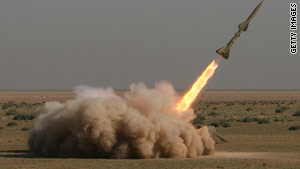
Iran to conduct military exercise aimed at protecting nuke sites

Iran test-fired missiles in September amid heightened tension over the country's nuclear program.


Tehran, Iran (CNN) -- Iran plans to launch a large aerial military exercise Sunday to prepare for any possible attack, state media said.

The five-day exercise was to cover a vast area in the country's northwest, west, south and southwest, Press TV said, citing Brig. Gen. Ahmad Miqani.

Iran's regular military and its elite Revolutionary Guards were to participate in the exercise against aerial attacks, especially against Iran's nuclear plants, according to Press TV.

The report did not offer further details about the scope of the exercise, but came as world powers have been strategizing about how to deal with Iran's apparent rejection of a key part of a nuclear deal.

The United States, Russia, China, Germany, France and the United Kingdom, along with the European Union, are trying to map a way forward on Tehran's controversial nuclear program. They seek to reduce international fears that Iran wants to develop nuclear weapons.

On Wednesday, Iranian Foreign Minister Manouchehr Mottaki said his country refused a request to send its partly enriched uranium abroad to be turned into material for medical research.

However, he said, Tehran might allow the nuclear material to be reprocessed inside Iran, the semiofficial ISNA news agency reported.

The nuclear deal, hammered out in October with the help of the International Atomic Energy Agency, is aimed to reduce the amount of raw material Iran has to build a nuclear bomb.

President Obama has warned of "consequences" if Iran does not accept the plan.

Iran says it intends to produce nuclear energy only for peaceful purposes, including civilian electricity and medical research.

Iranian media reported on Saturday that, according to a senior Iranian lawmaker, the country is capable of producing partly enriched uranium up to 20 percent, but had requested to buy the fuel from other countries instead. The move was described as a sign of good will.

"Given that Iran is capable of enriching uranium to a level more than 5 percent inside the country, it could well take a step to produce the fuel for its Tehran (research) reactor," said Kazem Jalali, of the parliament's national security and foreign policy commission, according to Press TV.

However, Iran sees buying the fuel as a better option, he said.
Posted by MK at 1:20 AM No comments:

Awash in Unintended Consequences

By Jim Hoagland
WASHINGTON -- Few things are as dangerous in the Middle East as well-intentioned outsiders. They invariably bring unintended consequences upon those they would guide to a better life. Ask Job. Or consider the case of Mahmoud Abbas, whose hurt and fury over foreign meddling has triggered his threat to quit as Palestinian leader.
No one could accuse President Barack Obama or Judge Richard Goldstone of South Africa of harboring ill will toward the president of the Palestinian Authority. But their separate worthy initiatives have resulted in pushing Abbas into a no-exit hell while lowering the chances for Israeli-Palestinian peace.


Receive news alerts


[+] More
Afghanistan is not alone. The Obama administration's wobbly approach to the Middle East peace process is also in urgent need of reassessment. Plan A -- to get concessions from Arab states to balance an Israeli freeze on settlement construction -- was abruptly abandoned after Obama was stiffed by both sides at a trilateral summit in September. Now the administration hopes to leapfrog the impasse over settlements by going straight into "final status" negotiations by getting agreement on conditional borders for an independent Palestinian state.
But the Arabs are newly upset and are moving the goal posts: They say the encouraging rhetoric of Obama's Cairo speech last June has been washed away by his failure to deliver the settlement freeze -- which has now become an Arab precondition for resuming negotiations with Israel.
Israelis, on the other hand, are newly confident of U.S. support, which rattles the Arabs even more. Prime Minister Binyamin Netanyahu got a cold shower from Obama and congressional leaders when he visited Washington in May. He was told that he should accept the principle of a Palestinian state, which he grudgingly did last summer.
But Netanyahu emerged from a Nov. 9 White House meeting with Obama able to claim credibly that the two men had talked as allies about Middle East peace and Iran's nuclear program -- with Obama setting a new end-of-December deadline for his engagement efforts with Tehran to produce results. (That deadline had been September, and is almost certain to slip again.)
What happened in the interim? Part of the answer is Goldstone and his U.N.-commissioned report, which accuses Israel of committing war crimes during its January assault on the Gaza Strip. Stung by the accusations and prodded by Washington, the Israeli government -- which refused to cooperate with Goldstone's investigation -- is debating carrying out its own investigation of the Gaza operation.
Whatever the Goldstone report's merits -- and they are lessened by its deliberate demonization of Israel's motives and milquetoast exculpations of Hamas' actions -- it seems to have been written with no feel for the political consequences it would bring for the peace process. The report also ignored the concern it would create at the Pentagon and in other Western military headquarters with forces fighting guerrillas who use civilian populations and infrastructure as shields in modern asymmetrical warfare.
On Capitol Hill, misgivings about Netanyahu were buried in a reflexive gathering around Israel under U.N.-inspired attack. The Goldstone fracas also helped push the politically sensitive Obama White House back toward a more supportive, traditional U.S. attitude toward Israel. Abbas -- not glimpsing the quagmire he was lurching toward -- went along with Washington's request to ask the U.N. to delay taking up Goldstone's report, only to back down when Jordan and Egypt joined Hamas in unleashing ferocious criticism of Abbas in their media.
"He is hurt, and angry," says an Arab official who has talked to Abbas recently. "He has been let down by everybody, especially Egypt," which has tilted toward cooperating with Hamas at the expense of Abbas' Fatah movement in recent months. The Egyptian turn (caused more by internal succession problems than regional factors) has also antagonized Saudi Arabia, which is locked in an increasingly open and hostile war of words with Iran, Hamas' most important patron.
This is a combustible mix of betrayals, failures and intentions gone awry. So Netanyahu may yet throw Abbas a lifeline on settlements if only to keep his weakened opponent in office.
Israel's long occupation of Palestinian territory has helped produce the cynicism and weak leadership on both sides that confound would-be international shapers of peace and moral rectitude. Outsiders cannot resolve this conflict: Only an Israeli decision to end that occupation in fast order can lead to the security Israelis need and deserve, and the dignity Palestinians seek through a state of their own. That is the broader, more vital decision that Netanyahu needs to make.
Posted by MK at 1:18 AM No comments:

Friday, November 20, 2009

High-Income Tax May Be Needed for Afghan War Cost, Levin Says

By Viola Gienger

Nov. 20 (Bloomberg) -- Carl Levin, chairman of the Senate Armed Services Committee, said higher-income Americans should be taxed to pay for additional troops sent to Afghanistan and that NATO should provide half of the new soldiers.
An “additional income tax to the upper brackets, folks earning more than $200,000 or $250,000,” could fund more troops, Levin, a Michigan Democrat, said in an interview for Bloomberg Television’s “Political Capital With Al Hunt,” airing this weekend. White House Budget Director Peter Orszag has estimated that each additional soldier in Afghanistan could cost $1 million, for a total that could reach $40 billion if 40,000 more troops are added.
That cost, Levin said, should be paid by wealthier taxpayers. “They have done incredibly well, and I think that it’s important that we pay for it if we possibly can” instead of increasing the federal debt load, the senator said.
Other countries in the North Atlantic Treaty Organization should bear responsibility for delivering half the additional troops needed to secure the conflict zone and train Afghan forces, Levin said. He didn’t predict how many troops President Barack Obama would add.
Levin also said Treasury Secretary Timothy Geithner, who has faced calls for his resignation from Republicans in Congress, should stay as long as he has Obama’s confidence. The six-term senator said the administration was right to move the prosecution of Khalid Sheikh Mohammed, the self-proclaimed mastermind of the Sept. 11, 2001, attacks, to federal court in New York from a military commission in Guantanamo Bay, Cuba.
Troop Decision Near
On Afghanistan, Obama may decide within a few weeks whether to grant a request from the top commander in the field, General Stanley McChrystal, for 40,000 more troops to fight the Taliban, which harbored al-Qaeda before being toppled in the invasion following the Sept. 11 attacks. The U.S. contributes about 70,000 of the 110,000 foreign forces fighting the Afghan war.
Levin, who has supported adding U.S. troops to the war mainly to train the Afghan army and police to take over, said he might back an increase closer to 40,000 under certain conditions. They include the proportion that would be used for training, a plan for preparing enough Afghan troops and a “major program” to provide equipment to their forces.
“There’s a lot of other things involved in showing resolve beside just a troop level,” Levin said. A key element to gain support will be “that whatever is announced, it be part of a NATO-Afghan initiative,” he said.
Conditions on Aid
The U.S. also should place conditions on aid that goes through Afghan President Hamid Karzai’s government to ensure that he cooperates in fighting corruption, Levin said. Karzai won re-election by default when his main challenger dropped out of a planned runoff after the first balloting in August was marred by allegations of fraud.
Levin said that while he wanted to be “hopeful” that Karzai would take steps to weed out corruption, “I’m also skeptical.”
Levin commended Pakistan’s leaders for turning more of their attention from their conflict with India to the Taliban and al-Qaeda fighters sheltering near the other border with Afghanistan. Pakistan’s army and its citizens have “taken some very severe losses” in fighting the militants, he said.
“They’ve got a way to go,” Levin said.
He also praised India, saying leaders had shown “restraint” in dealing with “fanatics” who crossed over the border from Pakistan.
On the economy, Levin said Geithner has been “very helpful” on finding ways to support automakers to preserve the industry.
Tighter Regulations
The broader financial crisis has demonstrated the need for tightening regulations on Wall Street, Levin said. He called the Obama administration’s recommendations “very significant.”
“I think the failure to move forward on those reforms in the Senate is the Republican resistance to some of those proposed reforms from the administration, not Democratic resistance,” Levin said.
He also praised proposals for changes from Connecticut Democrat Christopher Dodd, chairman of the Senate Banking Committee.
Dodd “has put forth a very significant reform of Wall Street,” Levin said. “It is long overdue.”
To contact the reporter on this story: Viola Gienger in Washington at vgienger@bloomberg.net
Posted by MK at 5:15 PM No comments:
Newer Posts Older Posts Home
Subscribe to: Posts (Atom)

Recent Headlines

  • ▼  2010 (11)
    • ▼  January (11)
      • The U.S. Isn't as Free as It Used to Be
      • Why America and China will clash
      • Have You Seen this Man? An "Aged" Osama Bin Laden ...
      • Blaming Israel First
      • U.S. Economy: Trade Gap Grows as Oil Prices Jump; ...
      • U.S. Shifts Iran Focus to Support Opposition
      • The Meaning of al Qaeda's Double Agent
      • What Does the Detroit Bomber Know?
      • The Ramzi Yousef Standard
      • Tehran Plans a Major Military Exercise
      • Democrats' worst nightmare: Terrorism on their watch
  • ►  2009 (57)
    • ►  December (22)
    • ►  November (35)